Lawrence Livermore National Lab Data Science Challenge 2026
I recently spent an exciting two weeks taking part in the Lawrence Livermore National Laboratory Data Science Challenge, where we applied agentic AI to real-world manufacturing problems. Additive manufacturing is rapidly expanding the materials available to scientists and engineers, enabling high-strength, low-density materials with complex internal lattice geometries. However, assessing the quality of these parts remains a persistent bottleneck, often requiring experts to manually review CT scans of the internal structure.
Over those two weeks I got to work with my amazing teammates Shir-Ling Sally Jin and Ernesto Gutierrez to develop an AI agent that detects defects in a 3D crystal lattice. We ran into plenty of challenges: noisy images, a low-data regime, and no perfect reference to compare against.
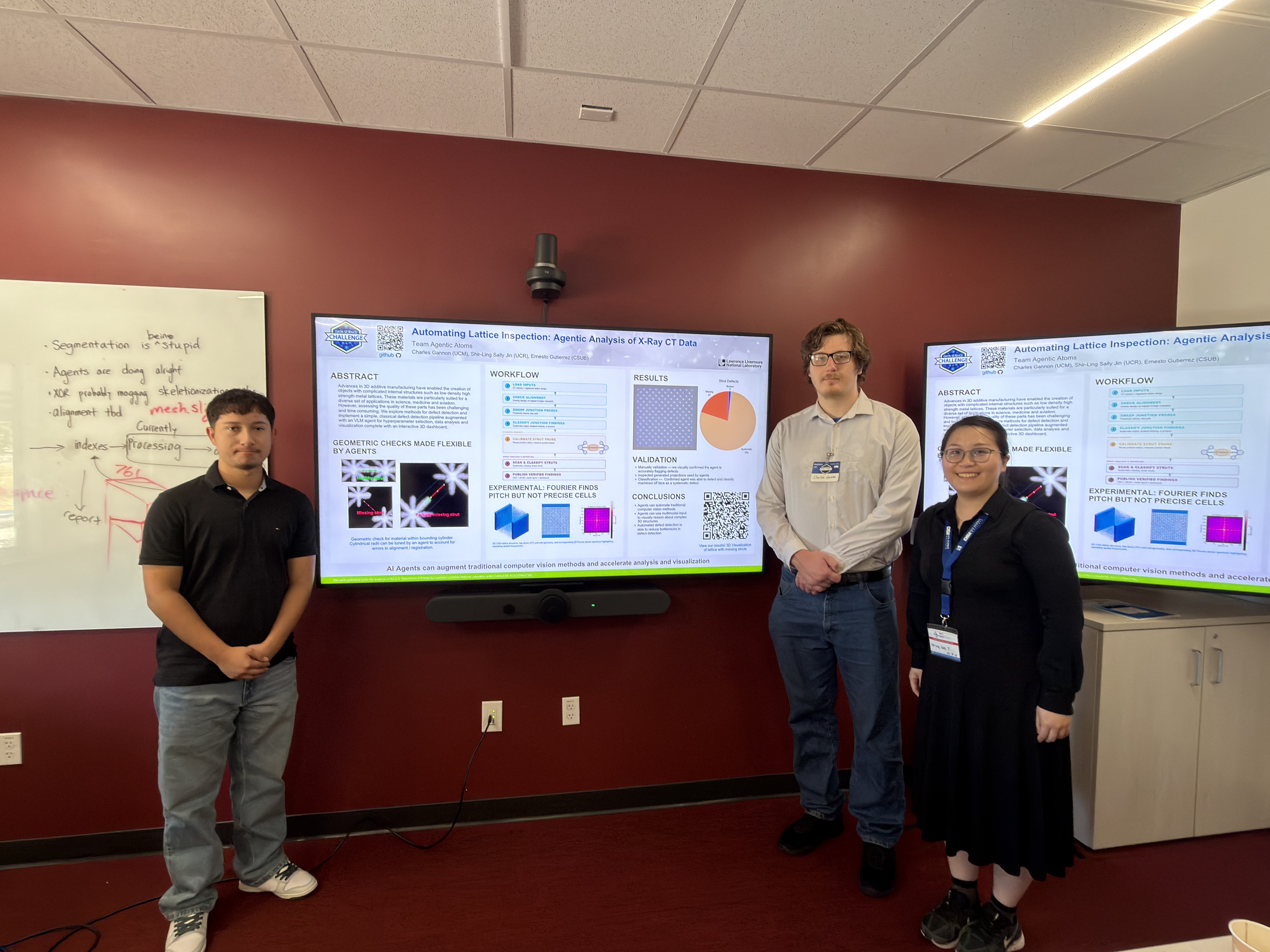
DSC 2026: My Team
My team and I presenting our poster.
From left to right: Ernesto Gutierrez, Charles Gannon
and Shir-Ling Sally Jin.
Our detection method stayed deliberately simple and interpretable — cylindrical "hitboxes" checking for missing structures in a segmented volume — and found ~95% of defects. Wrapping vision-language model agents around that traditional method gave us a pipeline where you hand over the CT scan plus the positions of the struts and junctions, and our pipleline is able to do the rest. The agent's job is narrow: it chooses a small set of pipeline hyperparameters, which scientists can inspect directly. The pipeline still runs perfectly well without the agent; providing the flexibility to use the it offline. Additionally, the agent is able to visually reason about the types of defects and what may have caused them. You can view a visualization of our results here and download our poster here.
The agent also reasons about defect types. It correctly assessed that the missing face of our crystal was a systematic problem with the data — not the kind of random defect we were hunting for. It then presents all of this to a scientist through an interactive 3D dashboard.
My favorite part of the experience was how much I learned. As a team lead, I got to see what it takes to lead in a technical environment. One of my biggest takeaways: ask for help when you need it — you don’t have to know everything. Shout out to the team lead meetings led by Omar DeGuchy, Brian Gallagher and Mary Silva for being a safe place to learn from and support each other. On the technical side, it's clear that AI agents are advancing to the point where a clearly described problem will often get a working solution. But over-engineered, brittle, and opaque solutions remain a common failure mode in agentic development. As scientists and engineers, we have to keep asking: how does it work, can we make it simpler, and how do we verify it?
Generative AI Disclosure: This blog post was written by me, then polished using AI for minor edits. The associated visualization was made using coding agents and AI assisted with some parts the associated poster.