Research
Currently, I am a 5th year graduate researcher at University of California Merced, working in Dr. Anna Nierenberg's group. My research focuses on simulations of dark matter for CDM as well as other dark matter models. I am particularly interested in exploring the vast dark matter model space using small scale, computationally efficient simulations (that you can run on your laptop!). If dark matter is something new to you, I hope you will stay and learn about one of the greatest mysteries in our universe. If dark matter / cosmology / simulations is something that gets you excited, you're in the right place!
Background
Energy Budget of the Universe
Credit: Wikipedia
Dark matter (DM) in combination with dark energy (Λ) make up the backbone of our current understanding of the universe, known as the Lambda Cold Dark Matter (ΛCDM) model. In the current epoch, dark matter constitutes approximately 27% of the total energy budget of the universe, and nearly 85% of the matter content (Planck Collaboration 2018). To good approximation, dark matter is cold (negligible thermal velocity), collisionless (does not interact with other particles) and dark (does not emit light or interact electromagnetically). The presence of dark matter is inferred through its gravitational influence on visible matter with evidence for dark matter coming from galactic rotation curves, gravitational lensing, stellar streams and the cosmic microwave background.
Despite significant effort, a particle detection of dark matter remains elusive. As a result, the nature of dark matter remains one of the largest unsolved mysteries in modern physics. Dark matter is well described by the Cold Dark Matter (CDM) model on large scales (think Milky Way scale and larger). Testing models of dark matter on the sub-galactic scale (much smaller than the Milky Way) is an ongoing and promising effort in the field. An exciting prospect in this regime is that deviations from CDM on small scales may provide clues to the particle nature of dark matter. However, many challenges remain. Baryonic physics (i.e. star formation, supernovae feedback, etc.) remains extremely uncertain in this regime which complicates the use of luminous matter as a tracer of the underlying dark matter distribution. Additionally, dark matter models predict "failed galaxies" that contain little to no luminous matter, making them difficult to detect observationally.
Gravitational lensing provides a promising avenue to overcome these challenges as it probes the total matter distribution (dark + luminous) directly. In Einstein's theory of general relativity, mass bends spacetime causing light to follow curved paths. Therefore, gravitational lensing is sensitive to all matter along the line of sight, regardless of its composition or whether it emits light or not. In this way, gravitational lensing is a powerful tool to probe the dark matter distribution on small scales, without the need for luminous tracers.
Projects
Quadruply Imaged Quasar
ESA/Hubble, NASA, Suyu et al.
While the properties of field halos are relatively well understood, the properties of subhalos remain uncertain and are an active area of my research. Subhalos evolve under the tidal field of the host halo, which can lead to mass loss and changes in the internal structure of subhalos; lensed subhalos in group mass galaxies are expected to lose ~98% of their mass. This presents a significant numerical challenge; subhalos probed by anomalous flux ratios are \( \gtrapprox 4 \) orders of magnitude less massive than their host halo at infall, making them difficult to resolve in cosmological simulations (even before tidal stripping!). Instead of using cosmological simulations to probe this regime, my work has focused on semi-analytic models and idealized simulations of subhalo evolution. My work has been focused on two main projects: characterizing the population-level statistics of dark matter halos predicted by Galacticus and developing a new class of 1D idealized simulations to model the tidal evolution of subhalos in self-interacting dark matter (SIDM) models.
Dark Matter Substructure: A Lensing Perspective
As probes of dark matter begin to explore the sub-galactic regime, an important question is: does the abundance of halos and subhalos match the predictions of CDM? Dark matter theories predict a population of low mass halos that increase in abundance with decreasing mass (down to the cutoff scale of the dark matter model). Understanding this cutoff scale is critical for constraining the particle nature of dark matter; for example, in some models of dark matter, such as warm dark matter (WDM), the abundance of low mass halos is suppressed compared to CDM, leading to a cutoff in the halo mass function at low masses. However, in anomalous flux ratio studies, the total abundance of subhalos (across all masses) is degenerate with the cutoff scale of the halo mass function, making it difficult to constrain the particle nature of dark matter without a good understanding of the abundance of subhalos. This is made difficult by the fact that the abundance of subhalos in cosmological simulations may be affected by numerical issues such as artificial disruption which leads to an underestimation of the abundance of subhalos (van den Bosch et al. 2018).
To explore the total number of subhalos expected in CDM, we use Galacticus (Benson et al. 2010) which is a semi-analytic model of galaxy formation that can be used to predict the properties of dark matter halos and their subhalos. In Galacticus, the histories of dark matter halos are generated using a Monte Carlo method based on the extended Press-Schechter formalism. The properties of halos and subhalos are then evolved using a set of analytic models for processes such as tidal stripping and dynamical friction. As Galacticus is computationally efficient, it can be used to generate large populations of halos and subhalos, making it a powerful tool for studying the statistical properties of dark matter halos and their subhalos. Because Galacticus uses a set of analytic models (instead of a finite number of particles), it is more resilient to numerical errors than cosmological simulations, making it a useful tool for studying the properties of low mass subhalos that are difficult to resolve in cosmological simulations.
Projected Spatial Distribution of Subhalos
The predicted spatial distribution of subhalos with mass > \( 10^8 M_\odot \) near the Einstein radius from Gannon 2025. The typical Einstein radius for a SLACS lens is shown as a dotted line. On average their are around 10 halos in this range for a \( 10^{13} M_\odot \) host
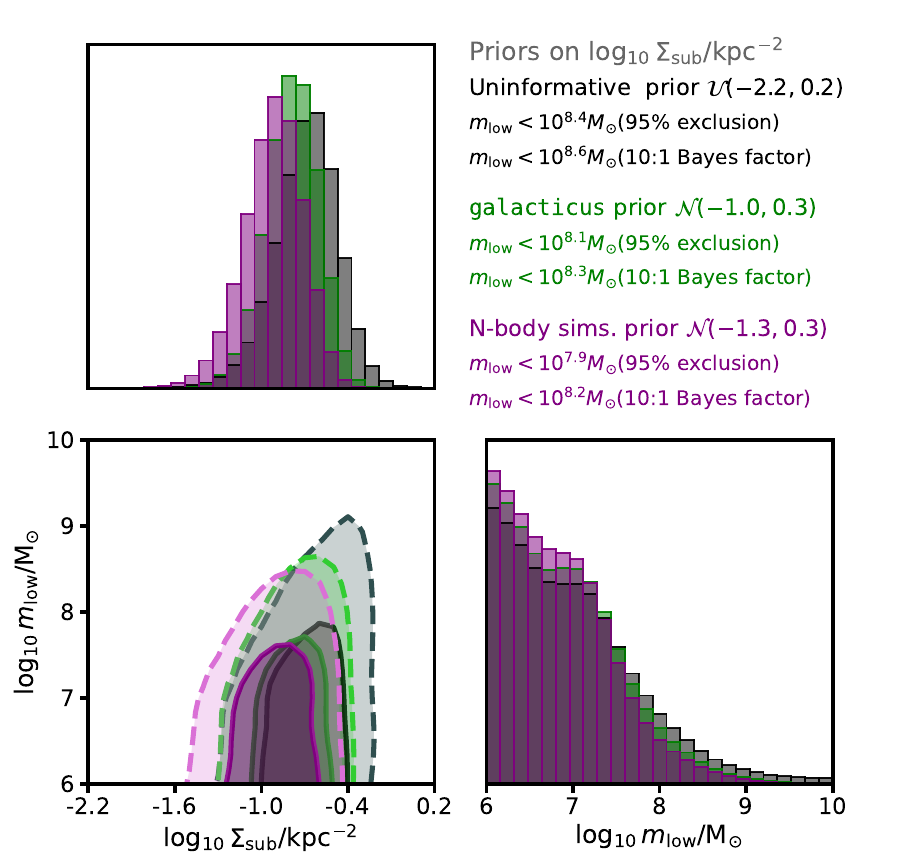
In this work we use Galacticus to characterize the population-level statistics of dark matter halos and their subhalos predicted by Galacticus, with a particular focus on the properties of subhalos that are relevant for gravitational lensing probes of dark matter. In the past, Galacticus has been tuned using cosmological simulations; however, these simulations may suffer from numerical issues that can be passed on to Galacticus through tuning. Our work uses a new tuning of Galacticus subhalo physics (Du et al. 2024) that is calibrated to ultra-high-resolution idealized simulations. We study the abundance, mass function and spatial distribution of subhalos in Galacticus (across nearly 2 orders of magnitude of host halo mass and over a large redshift range \( 0.3 \leq z \leq 1.0\)) and compare these predictions to those from cosmological simulations and analytic simulations. With the new tuning, Galacticus and cosmological simulations agree within a factor of ~2 in the abundance of subhalos, with the spatial distribution and mass function shape in reasonable agreement. In addition to our dark-matter-only suite, we include a suite of Galacticus runs with a realistically evolving central elliptical galaxy. Previous work on Milky Way mass halos has shown that the presence of a central galaxy can lead to a \( \sim 40 \% \) reduction in subhalo abundance (Yunchong et al. 2025); however, we find that on the group mass scale, the presence of a central galaxy has a negligible impact on the abundance of subhalos. This is likely due to the smaller baryon fraction on the group mass scale as well as the differing morphology between these two scales (i.e. elliptical vs disk galaxy). Previous lensing studies used nearly unbounded priors on the abundance of subhalos (i.e. allowing for a factor of 10 or more uncertainty in the abundance of subhalos) which led to weak constraints on the particle nature of dark matter; our work shows that the abundance of subhalos is much better constrained than previously thought, with an uncertainty of a factor of ~2 allowing for much stronger constraints on the particle nature of dark matter from lensing studies.
T1DES (Tidal 1D Evolution of Subhalos) in SIDM
In addition to warm dark matter (WDM), self-interacting dark matter (SIDM) is another class of dark matter models that can be probed by anomalous flux ratios of quadruply imaged quasars. SIDM has the potential to solve some of the small scale challenges to CDM, such as the diversity problem (Oman et al. 2015) and the highly dense structure inferred by strong lensing systems such as the jackpot lens (Vegetti et al. 2010). In SIDM models, dark matter particles have some non-zero self-interaction cross section which can lead to changes in the internal structure of dark matter halos and subhalos by facilitating heat transfer between the inner and outer regions of halos. In particular, SIDM halos go through two distinct phases of evolution: a core formation phase where the inner density profile of the halo becomes shallower and a core collapse phase where the inner density profile becomes steeper than CDM. The timescale for these halos is proportional to the relaxation time of the halo, which is inversely proportional to the self-interaction cross section and the density of the halo, $$ t_r \propto (\rho_{e} v_{e} \sigma_{m})^{-1} ,$$ with the core formation phase ending and the core collapse phase beginning at order \( \sim 100 \) relaxation times. Anomalous flux ratio studies of quadruply imaged quasars are particularly sensitive to the core collapse phase of subhalos, which can lead to an enhancement in the magnification of quasar images (Gilman 2021).
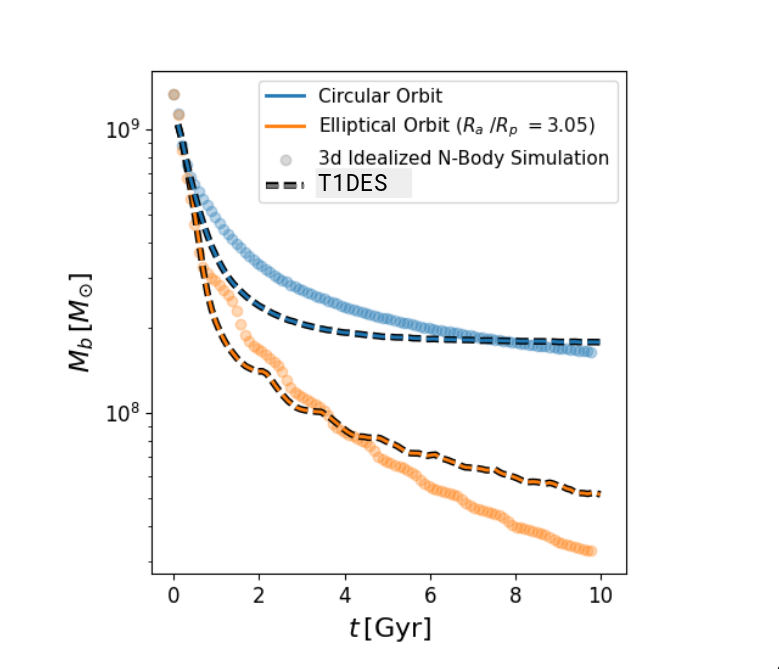
While the core collapse rate of field halos in SIDM has been studied extensively, the core collapse of subhalos in SIDM remains an active area of research — the profile of the subhalo evolves over time under a tidal field which can lead to changes in heat transfer within the subhalo. For example, using Gravothermal fluid modelling, Nishikawa et al. (2020) found that the core collapse of subhalos in SIDM can be accelerated by tidal stripping, with core collapse in some subhalos occurring 10 times faster than in isolation. Previous simulations of subhalos in SIDM have focused on three main methods: 1) cosmological simulations, 2) idealized simulations and 3) Gravothermal fluid modelling. While these methods have provided valuable insights into the evolution of subhalos in SIDM, they each have their own limitations. Both cosmological and idealized N-body simulations are computationally expensive, making it difficult to explore a large parameter space of subhalo properties and orbital parameters. Gravothermal fluid models are much faster, but previous work has used highly simplified models for the tidal evolution of subhalos, which may not capture the full complexity of the tidal evolution of subhalos in SIDM. To this end, we have developed a new class of 1D idealized simulations called T1DES (Tidal 1D Evolution of Subhalos) of dark matter SIDM halos. These simulations are many orders of magnitude faster than traditional 3D N-body simulations, allowing us to explore a large parameter space of subhalo properties and orbital parameters while still capturing the complicated tidal evolution of subhalos in SIDM. T1DES is still a work in progress, so stay tuned for more updates on this project!